Aluminum Extrusion
Custom aluminum extrusion, built to your drawing
We extrude custom aluminum profiles from your CAD drawing — designing the die, selecting the alloy and finishing the part so it arrives ready to assemble. No catalog, no stock profiles: every section starts from your specification. We can handle extrusion, machining, bending, welding and finishing as one project, so you do not need to coordinate several suppliers.
What custom aluminum extrusion means
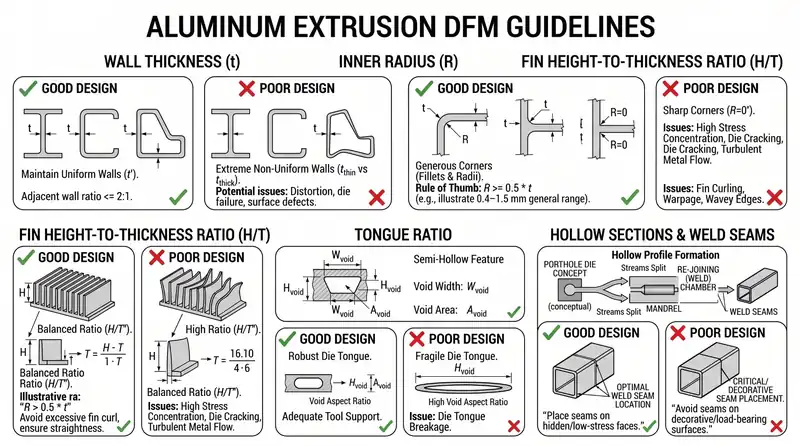
Extrusion pushes heated aluminum billet through a steel die to form a continuous cross-section. For custom parts, the die is designed around your profile, so the shape, wall thickness and features are yours alone — no one else stocks that section. It is the most efficient way to make a long, constant-cross-section aluminum part: rails, enclosures, heat-sink fins, frames and structural members all start here.
We run both direct (forward) and indirect (backward) extrusion, manage the welding seam for hollow sections, and control the discard so you get consistent, sound material. After extrusion we can age, straighten, CNC machine, bend, weld and finish the profile without changing hands. This reduces supplier handoffs between extrusion, machining and finishing.
The goal is simple: one supplier from your drawing to a finished aluminum component.
Why Teyalu for extrusion
- Die designed and owned per project (NDA available)
- Alloy and temper matched to your application
- DFM review before tooling reduces late changes
- Machining & finishing handled together
- English engineering support, 24h response
- One quote and one production schedule
From drawing to extruded profile — the process
Knowing the sequence helps you plan DFM and lead time. A typical custom extrusion job:
1 · Die design
We model the die from your section — port layout for hollows, feeder balance, and tongue support. A good die is half the quality.
2 · Billet & heat
Cast billet is homogenized and heated inside an alloy- and process-specific extrusion window. For many 6xxx alloys this sits in the high-400 °C range; the exact value depends on alloy and press.
3 · Extrude
Pressed through the die at controlled speed; the seam (hollow) and quench start here.
4 · Quench & age
Air or water quench then age (T5/T6) to reach temper. This sets strength.
5 · Straighten & cut
Stretch-straighten and cut to length or standard bars for secondary work.
6 · Secondary
CNC, bending, welding, anodize or powder coat — then inspect and pack.
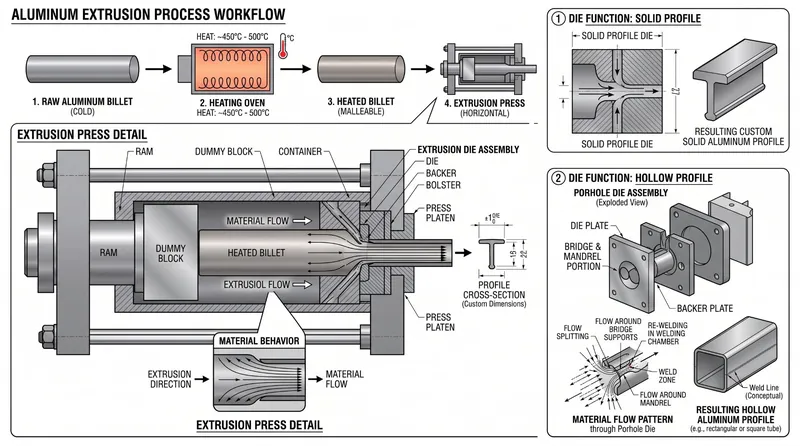
Extrusion design guide (DFM)
The earlier we review your drawing, the fewer revisions later. Key rules for an extrudable profile:
Wall thickness
Keep walls uniform. Practical minimum wall is around 1.0 mm for selected profiles, but the limit depends on alloy, section size and geometry — vary thickness gradually, not abruptly, because sudden steps cause fill and cooling problems.
Inner fillets
Use generous corner radii (≥ 0.5 mm). Sharp internal corners accelerate die wear and cause tearing at the die.
Fin limits
Fin height-to-thickness ratios around 20:1–40:1 may be achievable for selected geometries, but the practical limit should be confirmed during die design. Very thin, tall fins often need skived or bonded construction instead.
Weld seams
Hollow profiles have seams where the ports rejoin. Place them away from critical or cosmetic surfaces where possible.
Tongue ratio
Avoid slender tongues between slots — high tongue ratio dies are fragile and limit tolerance. Widen or support tongues.
Tolerances
Standard dimensional and form tolerances are available to EN 755-9; tighter tolerances can be achieved through profile optimization or secondary machining where required. See our tolerances guide.
Aluminum alloys we extrude
Alloy selection depends on strength, surface finish and machinability. A short, practical rule: 6063 is usually the first choice when surface finish and anodizing quality matter more than structural strength. Choose 6061 or 6082 when the profile will carry higher mechanical loads or require extensive machining. Common extrusion alloys and how they differ:
| Alloy | Typical use | Strength | Corrosion | Notes |
|---|---|---|---|---|
| 6063 | Architectural & general, fins | Medium | Very good | Best surface finish, easy anodize |
| 6061 | Structural, machined | High | Good | Weldable, versatile workhorse |
| 6082 | Structural, EU projects | High | Good | Common in Europe (EN AW-6082) |
| 6005A | Frames, rail, transport | Medium-high | Good | Good extrudability at thicker walls |
| 6060 | Thin-wall architectural | Medium | Very good | Smooth finish at lower strength |
| 7075 | High-strength (selected) | Very high | Fair | Available for selected geometries; much harder to extrude & anodize than 6xxx |
We do not list 5052 among our standard extrusion alloys: it is primarily a sheet, plate and drawn-tube material rather than a typical press alloy. If your part is formed from 5052 stock we can usually supply it as bar or tube instead. Full comparison incl. 6061 vs 6063 in our materials guide.
6061 vs 6063 vs 6082 — which alloy should I choose?
If you only remember one table, remember this. It answers the question engineers actually type: "Should I use 6061 or 6063 for aluminum extrusion?"
| Requirement | Recommended alloy |
|---|---|
| Best surface finish | 6063 |
| General structural use | 6061 |
| Higher structural loading | 6082 |
| Easy anodizing | 6063 |
| Machining-heavy component | 6061 |
| European structural projects | 6082 |
In practice the choice is rarely absolute. Many enclosures are 6063 for finish with a few 6061 machined brackets; many frames are 6082 where a spec calls for it. Send the loads, the finish and the machining scope and we will confirm the alloy during DFM review rather than guessing.
Can my aluminum profile be extruded?
A profile is generally a good extrusion candidate when the following hold. These are the same checks we run before quoting tooling:
- The cross-section stays constant along its length (extrusion makes one shape, repeated).
- Wall thickness is reasonably balanced — a section with one thick rib and one thin wall is harder to fill evenly.
- Internal corners use practical radii instead of sharp re-entrant angles.
- Thin tongues and deep, narrow slots are limited, or the die can support them.
- Hollow sections can be supported by a suitable port-hole die (the seam is planned, not accidental).
- Required tolerances can be reached by extrusion or by secondary machining where needed.
Not sure about your section?
Send us the CAD/STEP file and we review the section before die design — we will tell you what is extrudable as drawn, what to adjust, and where machining will carry the tight features. This step is where most cost and lead-time risk is removed.
When does extrusion need CNC machining?
Extrusion is cheap at making a long constant shape and poor at making precise local features. CNC machining fills that gap. Plan machining when your part needs any of these:
Holes & threads
Extrusion cannot put a located hole or thread in a wall. These are drilled or tapped after extrusion, often on the cut ends.
Tight tolerances
Features that must hold tighter than EN 755-9 are machined. Let the extrusion carry the loose bands and machining hit the critical ones.
Mating faces
Surfaces that seal, bolt or slide against another part are face-milled or fly-cut flat after extrusion.
3D or off-axis features
Pockets, angles and features that are not along the extrusion axis need milling or a secondary operation.
Designing this split early keeps cost down: over-specifying the extrusion tolerance is more expensive than machining a few features afterward. The CNC page covers our machining capability; the tolerances guide shows typical bands.
Extrusion capability & typical limits
| Parameter | Typical capability |
|---|---|
| Max profile width | ~350 mm flat / 250 mm CCD on 3600T; up to 500 mm via partner |
| Press tonnage | 600–3600 T in-house; 4000 T+ partner |
| Minimum wall | ~1.0 mm for selected profiles; limit depends on alloy, size & geometry |
| Length | up to 6 m (or cut to length) |
| Straightness | per EN 755-9 |
| Secondary | CNC, bending, welding, anodizing, powder coat |
Need a number before you commit?
- Tell us alloy, cross-section and quantity — we return a tooling estimate and lead time.
- MOQ and die cost depend on section size; share the drawing for an exact quote.
Profile families we build
Most custom aluminum parts fall into these groups — pick the closest and we'll tailor it:
Heat sink profiles
Finned sections for thermal management — our most specialized branch, from simple fins to bonded assemblies.
See heatsinks →Structural & frame
Non-standard structural sections and frames (not T-slot stock) for machines and fixtures.
See structural →Enclosures & housings
Extruded bodies for electronics, drives and inverters, often with machined end plates.
See enclosures →Tubes & bars
Round, square and shaped tubes and bars — feedstock for bending and machining.
See tubes & bars →Specialty profiles
Rails, slides, solar frames and other custom cross-sections for your application.
See specialty →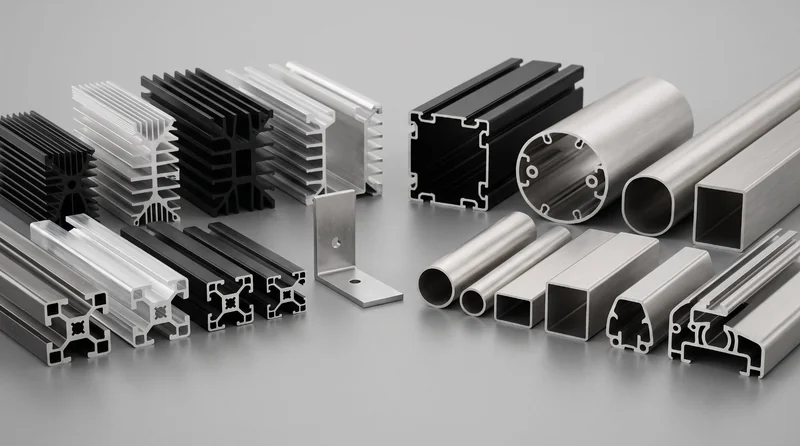
Industries that buy custom extrusion
Power electronics
Inverter and converter housings, busbar carriers, heatsink fins. See power electronics.
EV charging
Cabinet frames, cooling plates and enclosures for charge points.
Industrial automation
Linear rails, machine frames and fixtures — precise, repeatable sections.
LED & lighting
Extruded heat-sink channels and housings for luminaires.
Telecom & data center
Rack rails, enclosures and thermal management plates.
Medical & instrument
Clean, tight-tolerance structural and housing sections.
Tooling, MOQ and lead time
Custom extrusion needs a die, so the first question buyers ask is cost and volume. Typical production pattern:
- Die: owned per project; one-time, returned in the quote. NDA available to protect your section.
- MOQ: from a few hundred meters / thousands of pieces for small sections; share quantity for the band.
- Lead time: typical tooling and first-article lead time is measured in weeks, depending on profile complexity, die design and finishing requirements; repeat orders are much faster.
- Sampling: we can supply extruded bars for your own machining before full finishing.
Send to get a quote
- Drawing (CAD / STEP / PDF)
- Alloy & temper
- Quantity & annual volume
- Finish (anodize / powder / none)
- Critical tolerances
How a real project runs — example
The sketch below is a finned profile cross-section: a constant base with vertical fins, the kind of section extrusion makes efficiently. Wall, fillet and fin ratio are the three numbers that decide whether a die will run cleanly.
Illustrative project
Used to show the workflow; replace with your real data before publishing.
- Alloy / temper
- 6063-T5
- Profile
- LED heat-sink channel, 60 mm wide, constant cross-section
- Length
- 2.5 m, cut to length
- Finish
- Clear anodize, Type II, ~10 µm
- Tolerance
- ±0.15 mm on CNC-machined end faces; EN 755-9 elsewhere
- Volume
- 20,000 pcs / year
Workflow: STEP drawing → DFM review → die (port-hole for the channel) → first extrusion → quench & age → straighten & cut → CNC end-mill → anodize → final inspection & pack.
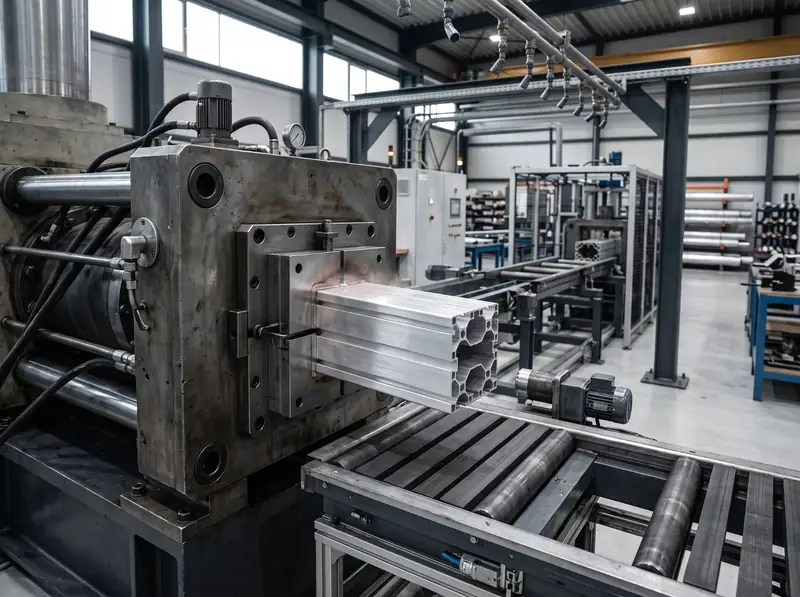
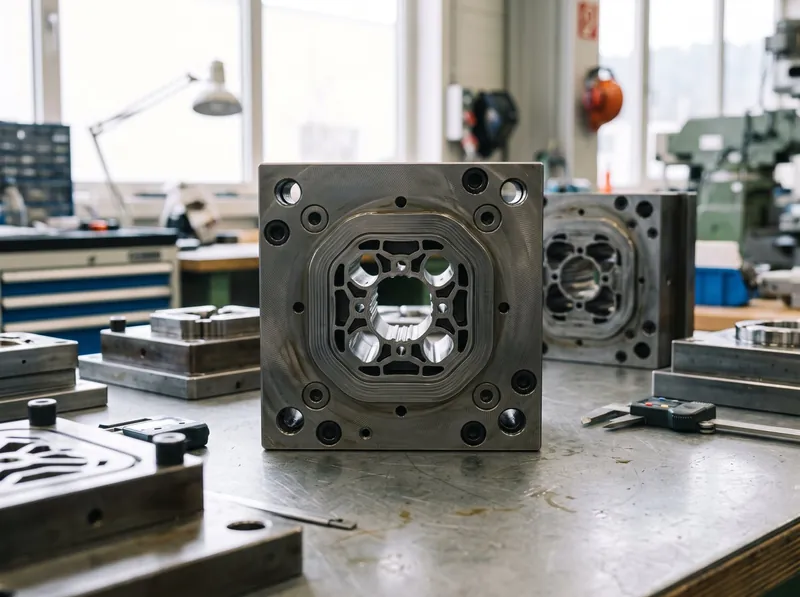
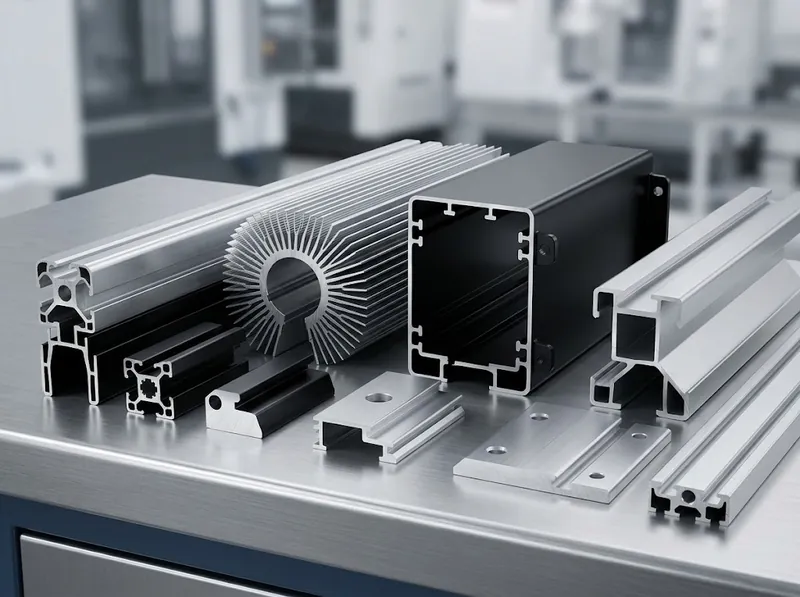
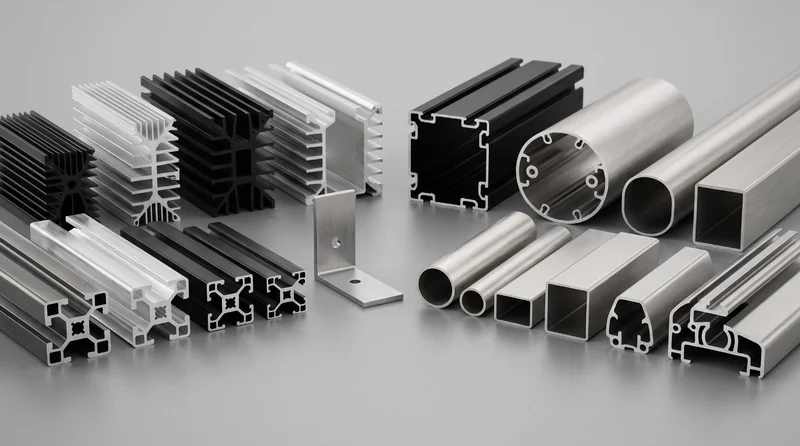
Production photos below show typical extrusion press, die, anodized profile and inspection stages on the factory floor.
Frequently asked questions
What is the minimum order quantity for custom aluminum extrusion?
MOQ depends on profile size, die cost, alloy and annual volume. For many projects, production starts from a few hundred meters or a few thousand pieces, but small engineering runs or prototypes may be possible depending on the section and tooling arrangement. Share the drawing and required quantity and we can recommend the most economical production quantity — for early validation we can often supply extruded bars before full finishing.
How much does an extrusion die cost?
Die cost scales with section size, complexity and the press required. It is a one-time tooling charge quoted per project; we own, store and maintain the die for your reorders, so you do not pay for it again. Small, simple solid sections are the lowest-cost end; large or hollow dies with complex port layout cost more. Share the CAD/STEP file and we return a tooling estimate together with lead time before you commit.
6061 or 6063 — which should I pick?
Choose 6063 when surface finish and anodizing quality matter more than structural load — it is the easier alloy to extrude and anodize, common for architectural and finned parts. Choose 6061 for higher strength, welding and heavier machining; 6082 where European structural specs or higher loading apply. The full trade-off is in our materials guide and the alloy-selection table above. If you are unsure, send the loads and finish and we will recommend the alloy during DFM review.
Can you hold tight tolerances on an extruded profile?
Standard dimensional and form tolerances follow EN 755-9 and suit most profiles as-extruded. When a feature needs a tighter band than extrusion can hold, we CNC-machine it after extrusion — holes, threads, mating faces and flatness are typical post-machining items. For critical geometry, design the extrusion to carry the loose tolerances and let machining hit the tight ones; that is usually cheaper than over-specifying the extrusion. See the tolerances guide for typical bands.
Do you make T-slot framing?
No. We build non-standard custom structural sections to your drawing, not catalog T-slot stock. T-slot is a standardized, off-the-shelf system; custom extrusion is the opposite — the die is made for your section. If you need a framed enclosure or fixture, we extrude the profile you design and machine the joints, rather than reselling standard slots.
Can extrusion be combined with other processes?
Yes — that is our default workflow. A typical job runs die → extrude → quench/age → straighten/cut → CNC machining → bending or welding → anodize or powder coat, then inspect and pack, handled as one project with one quote and one lead time. Keeping extrusion, machining and finishing under one roof reduces supplier handoffs and the dimensional risk that comes from moving parts between shops.
What file do you need to quote?
A drawing in CAD, STEP or PDF plus alloy, quantity and finish gets an accurate quote. A 2D PDF with key dimensions is enough for a budget number; a 3D STEP model lets us run a proper DFM review and flag risks before tooling. If you only have a concept sketch, send it — we can propose an extrudable section and confirm the die approach with you.
How do you protect my design?
NDA available on request; the die is project-specific and not resold or reused for other customers. We sign before drawings change hands when you ask. Your section, tolerances and finishes stay tied to your project, and we do not list customer-specific profiles in our catalog. For sensitive work, tell us the confidentiality level you need and we match it.
Can you extrude 7075 aluminum?
7075 is available for selected extrusion geometries, but it is significantly more difficult to extrude than the common 6xxx alloys and harder to anodize to a clean finish. It is best reserved for sections where its very high strength justifies the extra die and process cost. For most structural and heat-sinking parts, 6061 or 6082 give better extrudability and lower cost. Send the section and we will tell you whether 7075 is practical for it.
What is the typical tooling and first-article lead time?
Typical tooling and first-article lead time is measured in weeks, depending on profile complexity, die design and finishing requirements — simple solid sections are faster, large or hollow dies with secondary machining take longer. Repeat production orders run much faster because the die is already qualified and stored. Share the drawing and we return a dated plan: die build, first extrusion, sampling and full production.
Can the die be reused for repeat orders?
Yes. The die is yours for the life of the project — we store and maintain it and reuse it for reorders at no extra tooling charge. Die life depends on alloy, section and volume, and we monitor wear during production. When a die reaches its limit we advise before quoting a replacement, so your repeat pricing stays predictable.
Send your profile drawing for a quote
CAD, STEP or PDF — we'll return alloy, DFM notes and pricing. Or get a free DFM review first: send the drawing and we flag risks before you tool.